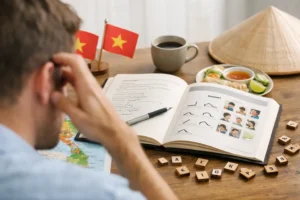
If you have ever bought a Vietnamese textbook, opened to page one, and immediately wondered whether you were learning a language or decoding a sound engineering manual, you are not alone. Finding the best Vietnamese textbooks for self study is harder than it should be, especially for adult learners who want clear structure, useful dialogue, and explanations that do not assume a classroom teacher is filling in the gaps.
That is the real challenge with Vietnamese. A book can look polished and still be a poor choice for self-study if it moves too fast on tones, gives little pronunciation support, or teaches vocabulary you are unlikely to use. On the other hand, the right textbook can give you a strong base before you move into a Vietnamese language course, learn Vietnamese online, or work with a Vietnamese tutor online. The best choice depends on how you learn, how much structure you need, and whether your goal is conversation, literacy, or long-term fluency.
How to choose the best Vietnamese textbooks for self study
A strong self-study textbook needs to do more than present vocabulary lists and grammar notes. It should guide you through pronunciation carefully, build sentence patterns in a logical order, and give enough review for the language to stick. That matters even more in Vietnamese because pronunciation is not a side issue. If a beginner does not spend enough time on tones, vowel distinctions, and listening practice, bad habits become difficult to fix later.
For adult learners, I would also look at how practical the content feels. Some books are academically sound but full of stiff dialogues that do not reflect real conversation. Others are friendly and accessible but too light to support steady progress. The best materials usually sit in the middle – structured enough to teach well, natural enough to keep you engaged.
If your longer-term plan includes Vietnamese lessons for beginners, an online Vietnamese course, or a conversational Vietnamese course, a textbook should support that path rather than compete with it. Good books help you prepare for live instruction. They rarely replace it completely.
1. Elementary Vietnamese
For many serious beginners, Elementary Vietnamese is one of the safest starting points. It is structured, clear, and designed to build a foundation instead of throwing useful phrases at you without explanation. The pronunciation work is one of its strongest features, which makes it especially valuable if you are trying to learn Vietnamese correctly from the start.
The trade-off is that it can feel a little formal. Some learners will appreciate that discipline. Others may find it less lively than newer materials. Still, if you want a textbook that respects the learning process and gives grammar enough attention, this is a strong contender.
2. Colloquial Vietnamese
Colloquial Vietnamese is often recommended for self-learners because it is accessible and conversation-oriented. The pacing is usually manageable, and it tends to be less intimidating than more academic titles. If your priority is speaking and listening in everyday settings, this book may feel more immediately rewarding.
That said, accessible does not always mean complete. Some learners find that it works best when paired with extra listening, pronunciation drills, or a teacher who can correct tone production. It is a useful book, but for true beginners studying alone, it may need support.
3. Teach Yourself Complete Vietnamese
This series is popular for a reason. It is built for independent learners, and that matters. The explanations are generally straightforward, the chapters follow a sensible progression, and the tone is encouraging rather than overly technical. For busy adults balancing work and study, that can make a real difference.
Its main advantage is usability. You can pick it up, follow it, and feel that you are moving somewhere. Its limitation is depth. If you become serious about Vietnamese, you may outgrow it and need more targeted practice in grammar, listening, and conversation. Still, as a starting point, it is one of the more practical choices.
4. Vietnamese for Beginners
Books with this title vary by publisher, so it is worth checking the table of contents before buying. In general, beginner-focused titles under this label are designed to make the first steps less overwhelming. That can be very helpful for learners who want a gentle introduction before joining a Vietnamese course for adults.
The risk is inconsistency. Some beginner books are excellent at introducing common phrases but weak on structure. Others cover too much too quickly. If you choose this type of textbook, make sure it includes pronunciation guidance, answer keys, and enough exercises to test understanding rather than just exposure.
5. Southern Vietnamese for Beginners
This is where your goals matter. Vietnamese textbooks often lean toward one regional variety, and not every book makes that clear enough. If you specifically want southern pronunciation, a textbook built around Southern Vietnamese can save a lot of confusion later.
For learners with family, social, or travel reasons tied to southern speech, this kind of book can be a better fit than a general textbook. The downside is that niche books sometimes have fewer companion resources and less polished exercise design. Even so, the regional match can outweigh those issues if authenticity matters to your learning goals.
6. Conversational Vietnamese-focused workbooks
Some textbooks are less like formal courses and more like guided speaking workbooks. These can be useful if your main aim is to speak with confidence in everyday situations. For adults who want practical phrases, dialogue repetition, and real-life scenarios, this format can feel more relevant than traditional grammar-heavy books.
Still, there is a catch. Conversation-first books often create the feeling of fast progress while leaving gaps in sentence building and comprehension. If you want to learn Vietnamese in a lasting way, these books work best as supplements, not your entire system.
7. Vietnamese grammar reference books
A grammar reference is not usually the first book you should buy, but it can become one of the most useful. Once you move beyond survival phrases, you begin noticing patterns, exceptions, and sentence structures that need clearer explanation. That is where a dedicated grammar text helps.
For self-study, though, grammar references are rarely enough on their own. They explain the language, but they do not always teach it step by step. Think of them as support materials for learners who are already using a core textbook, taking a Vietnamese speaking course, or attending an online Vietnamese course.
8. Integrated textbook and audio sets
If a textbook comes with strong audio and well-designed review exercises, it immediately becomes more suitable for self-study. Vietnamese is a language you need to hear often, not just read about. Books that include dialogues, pronunciation drills, and repeated listening tasks usually outperform text-only options.
This is especially important for learners who cannot attend in-person classes right away and plan to learn Vietnamese online. A textbook with weak or limited audio can slow your progress, even if the written content is good. When comparing books, do not treat audio as a bonus. For Vietnamese, it is part of the textbook.
What actually works best for adult self-learners
If you are studying on your own, the best Vietnamese textbooks for self study are usually the ones that combine structure, audio, and realistic pacing. For most adults, that means a solid beginner textbook such as Elementary Vietnamese or Teach Yourself Complete Vietnamese, paired with regular listening and speaking practice.
That pairing matters because self-study has limits. A textbook can teach patterns and vocabulary. It cannot reliably tell you whether your tones are accurate, whether your pronunciation is drifting, or whether your speech sounds natural. Many learners reach a point where the book is no longer the problem – the missing piece is feedback.
This is why textbook learning often works best as part of a broader plan. You might begin with a book at home, then join a vietnamese language course when you are ready for structure and correction. You might start with self-study and later add a vietnamese tutor online for pronunciation support. Or you may use a textbook alongside an online vietnamese course if you prefer flexibility but still want teacher guidance.
For adult learners in Singapore, that blend is often the most efficient route. A textbook gives continuity between lessons. A teacher gives correction, accountability, and cultural context. At Vietnamese Explorer, this is exactly why structured teaching and self-study materials work well together rather than as competing options.
A simple way to decide
If you want the safest all-around choice, start with a structured beginner book that includes strong pronunciation support. If your main goal is conversation, choose a practical textbook but expect to supplement it. If regional pronunciation matters, pick a book that reflects the variety you actually want to speak.
Do not judge a textbook by how advanced it looks. The best book is the one you can use consistently for three months, not the one that impresses you for two days. Vietnamese rewards steady practice, careful listening, and repetition more than speed.
A good textbook can open the door, but your progress comes from what you do after page one.