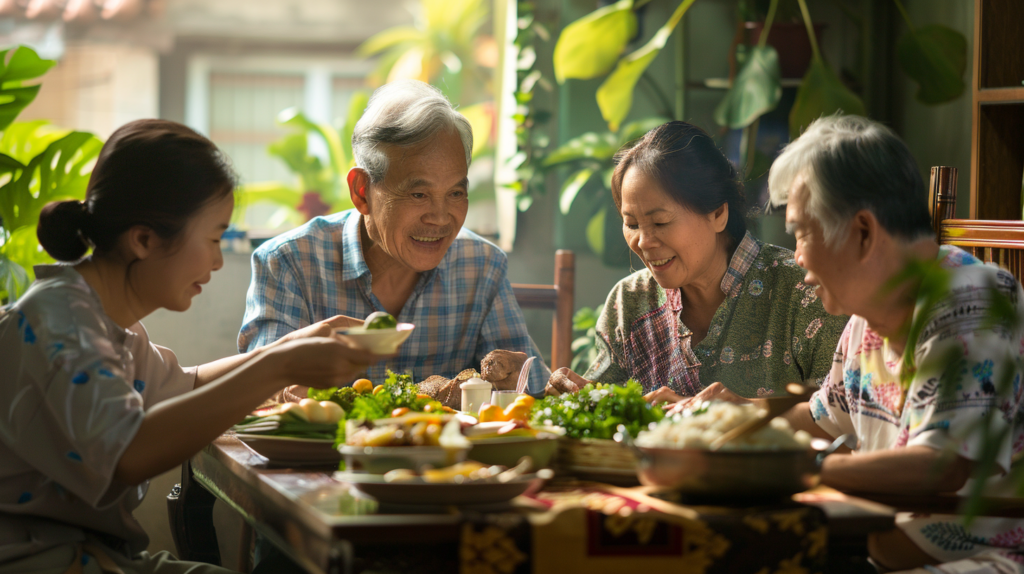
Understanding Vietnamese language and culture means seeing how family, age, respect, and social context shape everyday speech. This blog will walk you through the cultural features that influence Vietnamese communication, from pronouns and politeness to hierarchy, indirectness, and regional usage.
Why language and culture are inseparable in Vietnamese
Vietnamese is not a language you can learn well by memorising vocabulary alone. A word choice that sounds correct in grammar can still feel rude, distant, or unnatural if it ignores age, relationship, or setting. That is why learners who want practical fluency often do better with a structured Vietnamese course in Singapore that teaches cultural use alongside sentence patterns and pronunciation.
Vietnamese belongs to the Vietic branch of the Austroasiatic language family, uses tones to distinguish meaning, and is written in Quốc ngữ, a Romanized writing system marked with diacritics for vowels and tones. Those are the technical features. The social features matter just as much. Pronoun choice, kinship terms, and the tone of a response all carry cultural meaning. Britannica’s overview of Vietnamese and its entry on Quốc ngữ show the linguistic foundation, while classroom and proficiency frameworks make clear that successful use depends heavily on social appropriateness.

The Vietnamese pronoun system reflects relationships, not just grammar
One of the clearest ways culture shapes Vietnamese is through pronouns. In English, “I” and “you” cover most situations. In Vietnamese, speakers often choose forms based on age, family role, social rank, intimacy, and respect.
The University of Wisconsin’s Vietnamese Oral Proficiency Guidelines notes that Vietnamese has a complex personal pronoun system, and that correct use depends on gender, relationship, and other contextual factors. Misusing those forms can disrupt communication, even when the sentence is grammatically correct.
Why “you” is not really one word in Vietnamese
A beginner may expect a direct equivalent for “you.” In practice, Vietnamese offers many ways to address someone, and each one signals a different relationship. A younger speaker might say anh to an older man, chị to an older woman, em to a younger person, or cô and chú in other respectful adult contexts. These are not decorative extras. They are part of how the sentence works.
That is why Vietnamese honorifics and pronouns often feel difficult for foreigners. The challenge is not vocabulary size. The challenge is social judgment.

Kinship terms move beyond the family
Vietnamese uses kinship terms far outside literal family life. A shop assistant, colleague, neighbour, or teacher may be addressed with terms that originally describe family roles. Michigan State University’s Basic Vietnamese culture notes show how kinship labels encode status, seniority, and family position in highly specific ways. In real conversation, that kinship logic extends into wider society.
A simple example
If you call a slightly older woman chị, you are not claiming she is your sister. You are positioning the interaction politely. If you call her em instead, you change the social direction of the exchange. The sentence may still be understandable, but the relationship it creates is wrong.
Age and hierarchy influence how Vietnamese is spoken
Vietnamese social hierarchy in language is not abstract. It appears in greetings, requests, self-reference, and even short answers. Age matters. Seniority matters. Familiarity matters.
A younger employee addressing an older manager may choose softer wording and more respectful address terms. A child speaking to grandparents will use different self-reference from what the same child would use with a younger sibling. Learners who skip this layer often sound too blunt without realising it.
Addressing elders in Vietnamese requires cultural awareness
When speaking to elders, the speaker is expected to show respect not just through tone of voice, but through correct address terms. This is one reason Vietnamese speaking etiquette cannot be separated from social norms.
In many learning settings, students first notice this when they realise that self-reference changes too. You do not always say tôi for “I.” In many natural exchanges, you may say con, cháu, em, or another socially appropriate form depending on who you are speaking to. The “I” you choose tells the listener how you understand your place in the interaction.
Vietnamese politeness is relational, not formulaic
Some languages rely heavily on fixed polite phrases. Vietnamese politeness works more through relationship framing. The same request can feel warm, respectful, distant, or rude depending on the pronouns and kinship terms chosen.
This is why learners benefit from doing a Vietnamese proficiency test for level placement before joining a course. A student may know sentence structure but still need targeted work on social language use, especially with pronouns, honorifics, and culturally appropriate responses.
Family structure shapes vocabulary and social meaning
Vietnamese language cultural features are deeply connected to family structure. Kinship terms are precise because family position has long carried social importance in Vietnamese life.
MSU’s Vietnamese culture notes illustrate this clearly. Words for aunt, uncle, cousin, and in-law status vary by seniority, parental side, and relationship path. A father’s younger sister is not labeled the same way as a mother’s younger sister. The distinction is meaningful because language tracks family structure closely.
Kinship terms in Vietnamese are highly specific
This precision affects how learners should study vocabulary. It is not enough to memorise one general word for “aunt” or “uncle.” Vietnamese uses different terms depending on whether the relative is older or younger, maternal or paternal, or related by marriage. That makes the language feel dense at first, but it also makes relationships explicit.
Cultural meaning shows up in ordinary conversations
A family introduction in Vietnamese can reveal social order immediately. The terms chosen tell you who is older, which side of the family someone belongs to, and how people are positioned relative to each other. The language does not leave those relationships vague in the same way English often does.
For foreigners, this is one reason self-study can feel slow. Without cultural explanation, the vocabulary list looks random. With cultural explanation, the system becomes logical.
Vietnamese communication style often prioritizes harmony and context
People often search for “Vietnamese indirect communication style” because everyday interaction in Vietnamese can feel less direct than they expect. The important point is not that Vietnamese speakers are always indirect. The point is that many exchanges are shaped by context, face, and relationship management.
Direct wording is not always the best wording
In Vietnamese, a direct yes or no can be softened depending on who is speaking, to whom, and why. A refusal may come with cushioning language. A disagreement may be signaled through phrasing that protects the relationship. Politeness is often carried by framing, not just by formal polite markers.
That does not mean Vietnamese people avoid clarity. It means clarity is often balanced with social sensitivity. Learners who only translate from English sentence by sentence can miss this balance.
Why this matters in class and at work
In a business meeting, family gathering, or service interaction, success depends on more than vocabulary accuracy. It depends on reading the social distance correctly. Someone who uses correct verbs but mismatched pronouns can sound less competent than someone with simpler grammar but better cultural judgment.
Regional differences also carry cultural identity
Vietnamese is one language, but regional usage matters. Britannica notes that the standard language is based on educated speech in and around Hanoi, while regional dialects differ in pronunciation and some vocabulary. These differences are not just technical. They also reflect regional identity and everyday cultural experience.
Northern, Central, and Southern usage can feel different
A learner may hear different forms for parents, particles, everyday verbs, or sentence endings depending on whether the speaker is from the North, Central region, or South. That can be confusing at first, but it also teaches an important cultural lesson: Vietnamese is lived through regional communities, not only through textbook standardisation.
Standard Vietnamese is useful, but local usage matters too
For most learners, standard classroom Vietnamese is the right starting point. It creates a stable base. Still, exposure to regional speech is helpful because real conversations in Singapore, Vietnam, and the Vietnamese diaspora often include a mix of regional identities.
History has shaped Vietnamese vocabulary and writing
Culture influences language not only through manners and family life, but also through history. Vietnamese has borrowed heavily from Chinese over the centuries, and its modern writing system reflects missionary and colonial-era developments before becoming the national script. Britannica notes both the Chinese lexical influence and the historical development of Quốc ngữ.
Borrowed vocabulary still shapes modern expression
Many formal, literary, or administrative words in Vietnamese have Sino-Vietnamese roots. Learners may notice that everyday speech and formal vocabulary do not always feel identical in register. That difference is part of the language’s historical development.
Quốc ngữ made literacy more accessible, but tones stayed central
Even though Vietnamese uses a Roman-based script, it does not behave like English spelling. Diacritics carry essential information about vowels and tones. If you remove them, meaning becomes unstable quickly. That is why pronunciation and reading need to be trained together.
What foreigners usually misunderstand about Vietnamese language and culture
Many learners enter Vietnamese expecting a simple phrasebook language. The grammar may appear accessible in some areas, but the cultural layer is not optional.
Mistake 1: treating pronouns like direct translation
A learner sees you and wants one matching word. Vietnamese does not work that way. The social relationship comes first.
Mistake 2: learning phrases without context
A memorised sentence may work in one situation and fail in another if the pronouns, politeness level, or age relationship changes.
Mistake 3: ignoring cultural cues because the words seem easy
Vietnamese often uses short words and compact sentences. That surface simplicity can mislead learners into underestimating the cultural decisions inside each exchange.
How to learn Vietnamese with culture built into the process
The best approach is to study language and culture together from the beginning. Do not wait until “later” to learn pronouns properly. Do not postpone etiquette until after grammar. In Vietnamese, those systems are already fused.
A good learning sequence usually includes:
Start with relationship-based language
Learn greetings, self-reference, and address terms in paired social situations, not as isolated word lists.
Study vocabulary in real contexts
Family vocabulary, workplace language, and everyday service interactions should be practised with the correct social framing.
Use listening to notice culture in action
Listen for how speakers adjust pronouns, soften requests, or change formality. This helps you understand Vietnamese communication style from real speech, not just explanation.
Conclusion
Vietnamese reflects culture at every level of conversation, especially in pronouns, kinship terms, politeness, and hierarchy. Learners who understand those patterns sound more natural, avoid common mistakes, and communicate with more confidence.
If you want to speak Vietnamese in a way that fits real social situations, explore a course that teaches pronunciation, sentence patterns, and cultural use together so your language skills are useful from the start.
FAQs About Vietnamese Language and Culture
Why are Vietnamese pronouns so difficult for foreigners?
Vietnamese pronouns depend on age, relationship, gender, and social context. Unlike English, the system is not fixed around one “I” and one “you,” so learners must understand cultural hierarchy as well as grammar.
Are kinship terms really used outside the family in Vietnamese?
Yes. Kinship terms in Vietnamese are often used with non-family members to show respect, age difference, or social closeness. This is a major cultural feature of everyday communication.
Is Vietnamese communication always indirect?
Not always. Vietnamese communication can be clear and direct, but speakers often adjust wording to protect harmony, show respect, or fit the relationship. Context matters more than a simple direct-versus-indirect label.
Does Vietnamese culture affect business communication too?
Yes. Vietnamese business communication is shaped by politeness, hierarchy, and appropriate address terms. Using the wrong pronoun or level of formality can affect how professional or respectful you sound.