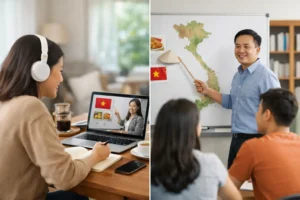
A working adult can be highly motivated to learn Vietnamese and still struggle to make progress if the class format does not fit real life. A late meeting, an unpredictable travel schedule, or the hesitation of speaking in front of others can all affect consistency. This Vietnamese class format guide helps you choose a learning setting that supports regular practice, practical conversation, and steady confidence.
The best format is not automatically the one with the most hours or the lowest fee. It is the one you can attend consistently, participate in comfortably, and use to practice the Vietnamese you genuinely need. For adults in Singapore, that often means choosing among private lessons, small-group classes, online learning, and employer-organized training.
Start With the Outcome You Want
Before comparing schedules or class sizes, be clear about your purpose. Learners who want to prepare for travel usually need useful phrases, listening practice, pronunciation support, and enough cultural context to handle everyday interactions respectfully. Those connecting with Vietnamese-speaking family or friends may prioritize natural conversation and the confidence to respond without translating every sentence internally.
A learner beginning from zero needs a different path from someone who can understand familiar phrases but cannot yet speak comfortably. Vietnamese lessons for beginners should create a solid base in sounds, tones, essential vocabulary, and sentence patterns. Skipping these foundations can make early progress feel quick, but it often creates confusion later when learners need to understand native speech or form their own answers.
If your goal is speaking, choose a Vietnamese speaking course that gives you frequent, guided opportunities to speak aloud. Watching explanations has value, but language becomes usable through listening, repeating, receiving corrections, and trying again in realistic situations.
Private Vietnamese Lessons: Maximum Personalization
Private lessons are often the strongest choice for learners with specific goals, changing schedules, or a preference for focused attention. The instructor can adjust the pace, revisit challenging pronunciation, and select vocabulary relevant to your daily life. This is particularly helpful for adults who have learned another language before but need support adapting to Vietnamese tones and sound patterns.
A private format also gives quieter learners more room to speak. Instead of waiting for a turn, you can spend most of the lesson practicing. An experienced instructor can correct errors in a supportive way, explain why a sound changes meaning, and build exercises around the areas that need the most work.
The trade-off is that private instruction requires active participation. There is no group energy to carry you through a session, and a missed class means losing valuable speaking time. It tends to suit learners who can commit to regular appointments and want a highly personalized approach.
Group Vietnamese Classes: Structure and Shared Momentum
A group Vietnamese language course offers a structured path alongside other adult learners at a similar level. For many people, this creates useful accountability. Seeing classmates work through the same unfamiliar tones and sentence patterns can make the learning process feel less intimidating.
Well-organized group classes should still provide meaningful speaking practice, not just teacher-led explanations. Look for sessions that include pair work, short role plays, listening exercises, and regular opportunities to form sentences independently. A conversational Vietnamese course is most effective when learners are encouraged to use new language during the lesson rather than simply memorize a list of words.
Group learning is a good fit when your schedule is stable and you enjoy a social classroom environment. However, it may be less suitable if you need to move much faster than the group, revisit one topic repeatedly, or reschedule often. Class size also matters. A smaller group generally gives each learner more time to speak and receive feedback.
Online Vietnamese Classes: Flexibility Without Losing Guidance
For busy professionals and frequent travelers, the ability to learn Vietnamese online can make the difference between starting and postponing. An online Vietnamese course removes commuting time and makes it easier to maintain a lesson routine from home, the office, or while away from Singapore.
Online learning works best when it remains interactive. A live instructor should be able to hear your pronunciation clearly, guide you through dialogue practice, use visual materials when needed, and correct misunderstandings before they become habits. Video-based instruction can be especially effective for listening and speaking when the session is designed for participation rather than passive viewing.
The main consideration is your learning environment. A quiet place, reliable connection, and willingness to speak on camera help create a productive lesson. If you find it difficult to focus at home, an in-person setting may provide more structure. If travel time is your biggest obstacle, learning online is often the more sustainable choice.
How to Evaluate a Vietnamese Tutor Online
When considering a Vietnamese tutor online, ask how lessons are adapted to your level and how pronunciation feedback is handled. Vietnamese is tonal, so clear and timely correction is essential. It also helps to ask whether lessons include practical listening practice and conversation, rather than relying only on slides or written exercises.
A qualified instructor brings more than native-level fluency. They can explain Vietnamese clearly to English-speaking adults, identify common learner errors, and make cultural details understandable without overwhelming the class. The right teacher makes each lesson challenging enough to build skill while keeping the experience encouraging.
In-Person Classes: A Dedicated Learning Space
Physical classes remain valuable for learners who prefer face-to-face interaction and a clear separation between study time and home life. Being in a dedicated classroom can improve concentration, especially after a long workday. It also allows instructors to notice subtle pronunciation and participation cues more easily.
For those searching for Vietnamese classes near me in Singapore’s central area, accessibility can be a practical deciding factor. Vietnamese Explorer conducts in-person lessons at International Plaza, directly above Tanjong Pagar MRT. A convenient location makes it easier to protect your learning time instead of letting a long commute become a reason to cancel.
In-person learning is not automatically better than online instruction. It depends on whether the classroom environment helps you show up consistently. The best choice is the format that gives you enough live interaction and realistic practice without placing unnecessary pressure on your schedule.
Corporate Training: Learn Alongside Colleagues
Corporate Vietnamese training can suit teams whose organization wants to support cultural connection, travel readiness, or everyday communication confidence. Learning with colleagues can create shared motivation and make practice feel more natural between sessions. Lessons can be arranged around a common starting level and practical conversational situations.
This format works well when participants have similar goals and the organization can protect time for attendance. It becomes less effective when learners have widely different abilities or cannot attend regularly. In those cases, a private or smaller group arrangement may deliver more personal progress.
What Every Effective Format Should Include
Regardless of whether you choose private, group, in-person, or online Vietnamese classes, the teaching approach matters as much as the delivery method. Strong adult instruction balances clear explanations with repeated use. You should understand what you are saying, hear how it sounds in natural speech, and practice responding without a script.
A quality Vietnamese course for adults should build from useful foundations toward increasingly flexible conversation. Early lessons may focus on greetings, introductions, numbers, food, directions, and polite requests. As confidence grows, learners should practice asking follow-up questions, describing experiences, and handling common conversations with less preparation.
Cultural knowledge should be part of that process. The right form of address, greetings for different situations, and the tone used in everyday exchanges all influence how language is received. Cultural context is not an extra topic. It helps learners communicate with greater awareness and ease.
Choose the Format You Will Actually Continue
There is no single best Vietnamese language course for every adult learner. Private lessons offer personal attention. Group classes provide structure and shared momentum. Online classes create flexibility. In-person sessions give many learners a more focused setting, while corporate training can make learning easier to sustain within a team.
Start with your real schedule, your comfort with speaking, and the situations where you hope to use Vietnamese. Then choose a format that gives you regular contact with a skilled instructor and plenty of time to listen, speak, and receive thoughtful feedback. Consistent practice in the right setting turns first phrases into conversations you can genuinely enjoy.